Find the Balance · Paradox 7
Make room, and stay visible
The more room you leave, the more others fill it.
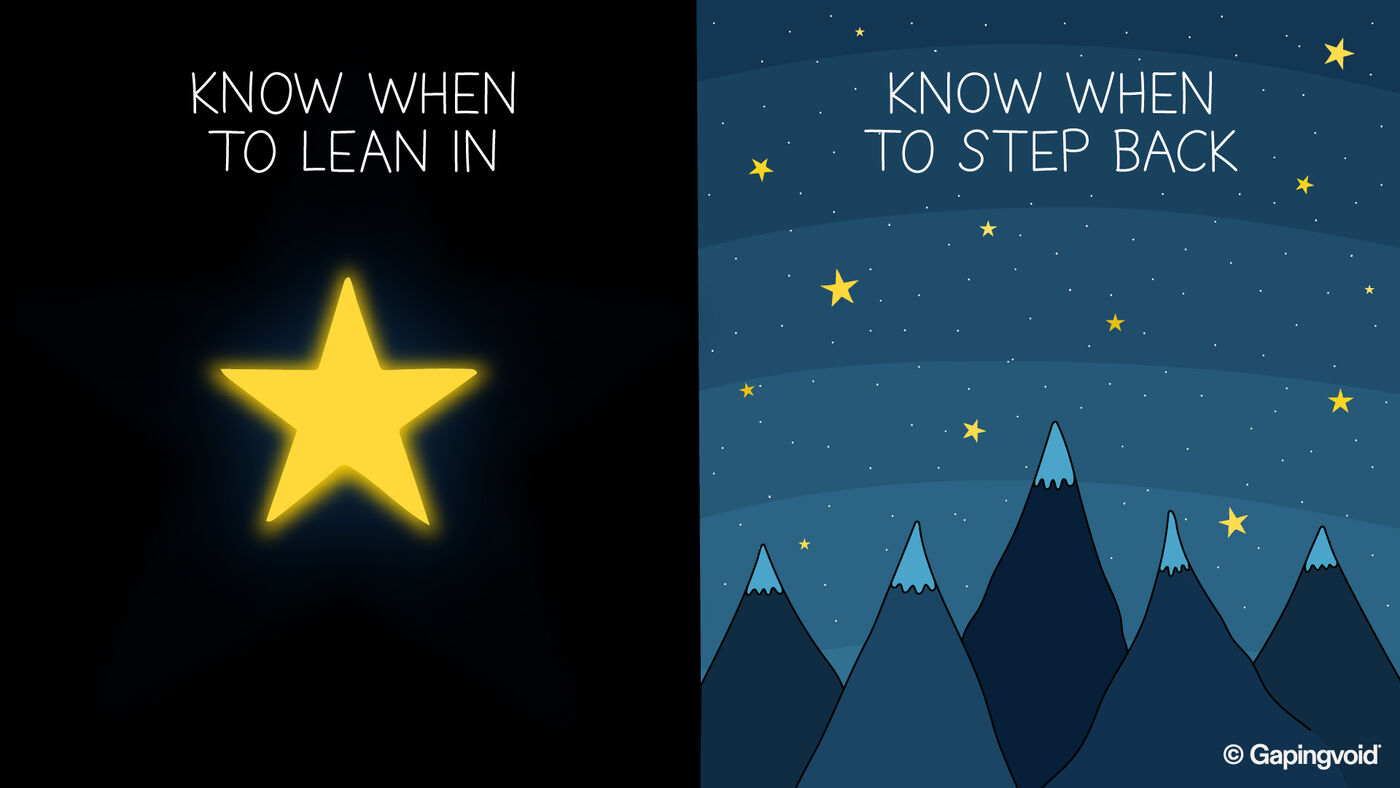
Part of Find the Balance, a series on the tensions every leader lives with: why we lean one way, what drives the lean, and one small move.
Most of us have been told at some point that the best leaders speak last. It’s good advice, and about half right. Speaking last gives other people room to think out loud, and it stops your view from becoming the answer before anyone else has offered theirs. But speaking last is not the same as not speaking at all, and in plenty of meetings the person with the most useful view says nothing and takes it home with them.
The paradox
Make room for others, and stay visible. Leaving space is one of the most underrated things a leader can do. It lets people grow into the work, brings out ideas that would otherwise stay quiet, and keeps the fastest voice from always winning. But space doesn’t stay empty for long. Somebody fills it, and the real question is whether what fills it is what the situation needed.
Too little, too much
On one side is Considering: listening first, weighing other views and leaving room for people to contribute. Done too little, it becomes crowding. You fill every pause, finish people’s sentences and offer your view first, then offer it again. From the inside it feels like engagement, but from across the table it feels as if the air has gone.
On the other side is Directing: putting your view on the table, setting a course and being seen to lead. Done too little, which is where heavy Considering usually ends up, you become invisible. You have a view but wait to be asked, or you think it through so carefully that by the time you’re ready, the decision has been made. Done too much, Directing does the crowding for you. The two sides lean on each other, so too much of one is very often too little of the other.
What each side invites
Crowding invites others to step back. People contribute less, wait longer and save their best thinking for conversations you’re not in. Invisibility invites the opposite, because others step in. Your silence gets read as agreement, or as having nothing to add, and over time people stop looking your way when a call has to be made. It rarely gets named, because quiet colleagues are easy to work with, which is partly why it costs so much. A team ends up with the balance it has rather than the one it needs: one or two people filling the room, and others quietly leaving it.
Within: why you lean
The belief behind too much Considering often sounds modest: my view isn’t really needed here, others know this better than I do, and saying what I think would be taking over. Sometimes it’s a belief about timing, that a view only counts once it’s fully formed. The belief behind crowding runs the other way: if I don’t say it, nobody will, and my value is in what I contribute out loud. Each is a first story about what will happen if you move, and it’s rarely tested. The quiet leader seldom checks whether people actually wanted their view, and the talkative one seldom finds out what the room would have produced without them.
Around: what the space rewards
Many workplaces quietly reward the loudest and fastest. The first confident answer becomes the working answer, and reflection reads as hesitation. In that kind of space, Considering loses out and crowding gets mistaken for leadership. Research by Daniel Ames and Francis Flynn found that leaders seen as too low or too high in assertiveness were both rated as less effective, with too much costing relationships and too little costing results. Which mistake you’re drawn to, and which one gets noticed, has a lot to do with the room you’re in.
There’s a horizon-and-ground point here too. People can handle a lot of room on the ground, in the day-to-day detail, provided they can see you on the horizon. Where you think the work is heading is the part people most need you to be visible on, and it’s the part quieter leaders most often leave unsaid.
They move
The leaders who handle this well treat airtime as something to manage rather than something that just happens. They notice who hasn’t spoken yet, and they hold their own view back until others have offered theirs. Then, when their view matters, they put it on the table plainly and early enough to count. Making room is a deliberate act with a purpose. Disappearing is what happens when nobody is making that choice any more.
The move
Try a little more of the opposite, as one small step rather than a swing. If you lean towards making room, choose one meeting this week where you hold a view on direction, and say it before the decision point, even if it isn’t fully formed: “Here’s where I’m landing, and I’d like to test it with you.” If you lean towards filling the space, choose one meeting where you speak only after at least three others have, and notice what surfaces that you hadn’t thought of.
And a question to sit with. In the last decision that really mattered, where was your view: on the table, or still in your head? If you asked the people in that room whether you take up too much space or too little, which would they say?
Find the Balance is one of Square Peg’s three practices, alongside Change the Story and Shape the Conditions.
References
- Ames, D. R., & Flynn, F. J. (2007). What breaks a leader: The curvilinear relation between assertiveness and leadership. Journal of Personality and Social Psychology, 92(2), 307–324. https://doi.org/10.1037/0022-3514.92.2.307
Want to talk about this with your team? Square Peg works with leaders on the conditions, beliefs and behaviour behind how they lead.
Get in touch