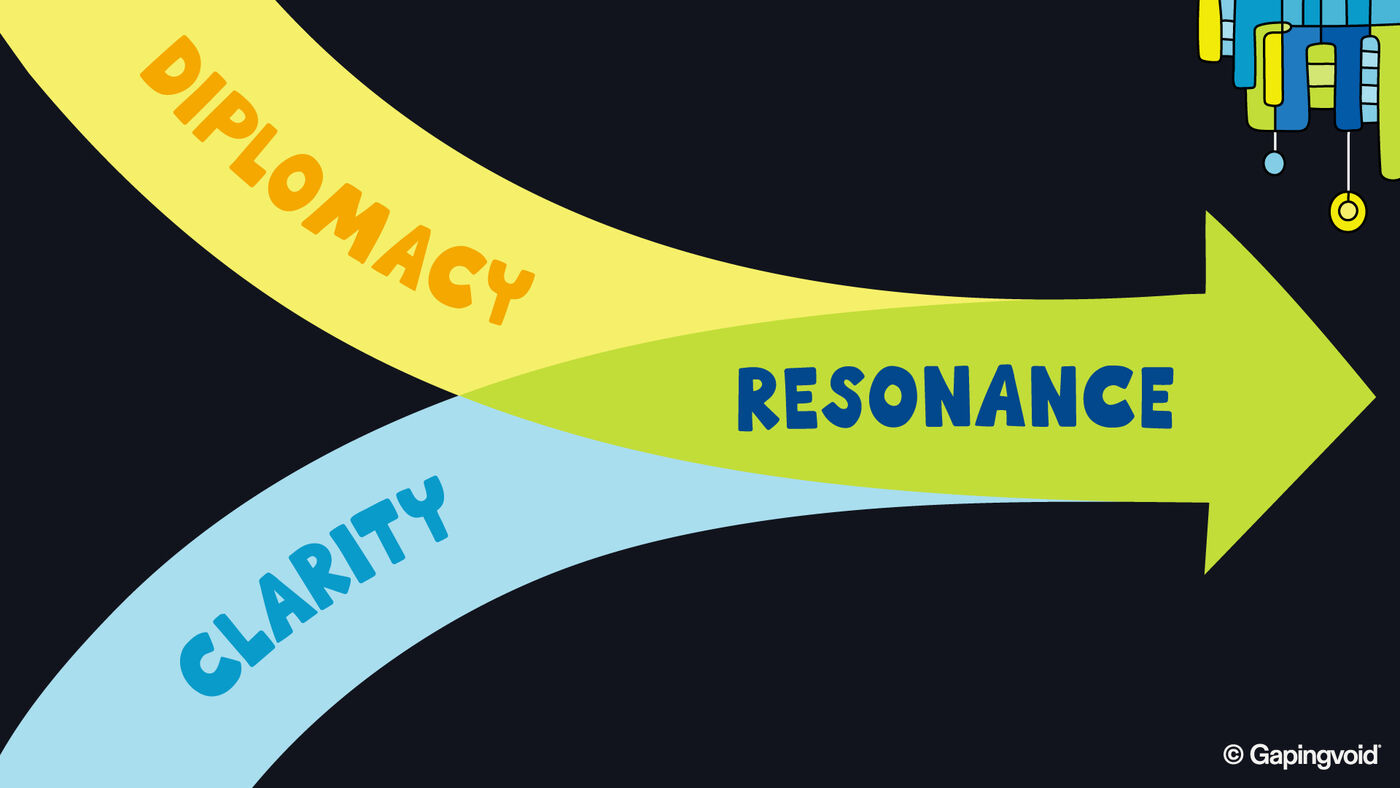
Part of Find the Balance, a series on the tensions every leader lives with: why we lean one way, what drives the lean, and one small move.
Bad news rarely arrives late because nobody knew. Usually somebody knew for a while and weighed up whether telling you was worth it. That weighing-up happens in every team, every day, and it’s shaped far more by the person receiving the news than by the person carrying it. Which leads to an uncomfortable pattern: the harder you push back, the less people tell you.
The paradox
Say it, and say it with tact. Every team needs someone willing to name the problem, disagree out loud and say “I don’t think this is right.” Plain speaking is a form of respect, because it treats people as able to hear the truth. But how something is said shapes whether it’s heard at all, and whether people will bring you the next hard thing. Tact isn’t a watering-down of honesty. Used well, it’s what lets honesty land.
Too little, too much
On one side is Being candid: saying what you see, naming what isn’t working and not leaving the important thing unsaid. Done too much, it turns combative. It might be the sharp email sent late at night, the public correction or the remark everyone notices and nobody names, all defended as honesty or high standards. Done too little, it becomes silence. The performance conversation keeps getting postponed, and the problem everyone can see goes unnamed.
On the other side is Adapting: reading the person and the moment, and adjusting timing, tone and approach to suit. Done too little, everything is delivered the same way to everyone, whatever they happen to be carrying that day. Done too much, the message gets softened until there’s nothing left of it, and people walk away reassured about something that should have worried them.
What each side invites
Here’s the twist in this paradox: both extremes end up in the same place. Combative candour invites silence, or a counter-attack, because people learn what happens when they say the wrong thing. Ideas get filtered before they’re shared, and bad news is held until it can’t be avoided. Over-adapting invites silence too, by a different route. A leader who never names problems teaches everyone else not to bother. Either way, the conversations that matter move out of the meeting and into the corridor, where they can’t do much good.
Within: why you lean
The lean is usually anchored by a belief about what honesty requires. If you lean towards bluntness, the first story is often “Honesty means saying it straight, however it lands.” It can feel like integrity, and it may have served you well somewhere nobody else would speak.
If you lean towards adapting, the first story is often “Conflict damages relationships.” That one feels like care. But each story treats delivery and truth as a trade-off, when they rarely are. A second story worth trying is simpler: “The point of saying it is that it gets heard.”
Around: what the space rewards
People don’t decide whether to speak up in a vacuum. Elizabeth Morrison’s review of the research on employee voice found that people speak up when they judge it to be both safe and worthwhile, and that judgement is built from history. If the last person who raised a concern was thanked and taken seriously, the next person is more likely to speak. If they were sidelined, or simply ignored, everyone learns from that too. Safety in a team is partly a record of how dissent has been treated before, and a leader adds to that record every time someone disagrees with them. Your reaction becomes part of the conditions, whether you mean it to or not.
They move
The leaders who get this right don’t pick one style and stick to it. They say the hard thing early, while it’s still small. They lead with a question when a question will help the other person see it for themselves, such as “How do you think that went?” And they make the point plainly when a question would only blur it. They also stay curious about how they come across, because the view from inside is partial. You may see yourself as simply direct while others hear an edge, or see yourself as tactful while others hear no message at all.
The move
Take one small step against your usual grain. If you lean towards Being candid, pick your next piece of difficult feedback and spend two minutes beforehand thinking about the person rather than the point: what they’re dealing with, and what would help them take it in. Then say it clearly, without the edge. If you lean towards Adapting, pick a concern you’ve been sitting on and, sometime this week, name it in one plain sentence before any cushioning: “I’m worried this won’t be ready in time.”
And a question to sit with. What’s the conversation you’ve been putting off, or the one you had too bluntly? When did someone last bring you bad news early, and what did you do with it? And if you asked your team whether they feel safe disagreeing with you, would they tell you the truth?
Find the Balance is one of Square Peg’s three practices, alongside Change the Story and Shape the Conditions.
References
- Morrison, E. W. (2011). Employee voice behavior: Integration and directions for future research. Academy of Management Annals, 5(1), 373–412. https://doi.org/10.1080/19416520.2011.574506
Want to talk about this with your team? Square Peg works with leaders on the conditions, beliefs and behaviour behind how they lead.
Get in touch