Find the Balance · Closing
Which way do you lean?
The self–other gap, and why the people around you keep you where you are.
Part of Find the Balance, a series on the tensions every leader lives with: why we lean one way, what drives the lean, and one small move.
Eleven paradoxes, and not one of them has a right answer. We’ve looked at being close and clear, stepping forward and stepping back, making the call while building agreement, your patch and the whole, candour with tact, trust that stays in touch, room that stays visible, reliance on others and on yourself, openness that is also clear, help that lets people struggle, and confidence that stays humble. Each pair holds two goods, and each good, pushed far enough, starts to produce the opposite of what it was meant to.
The thread
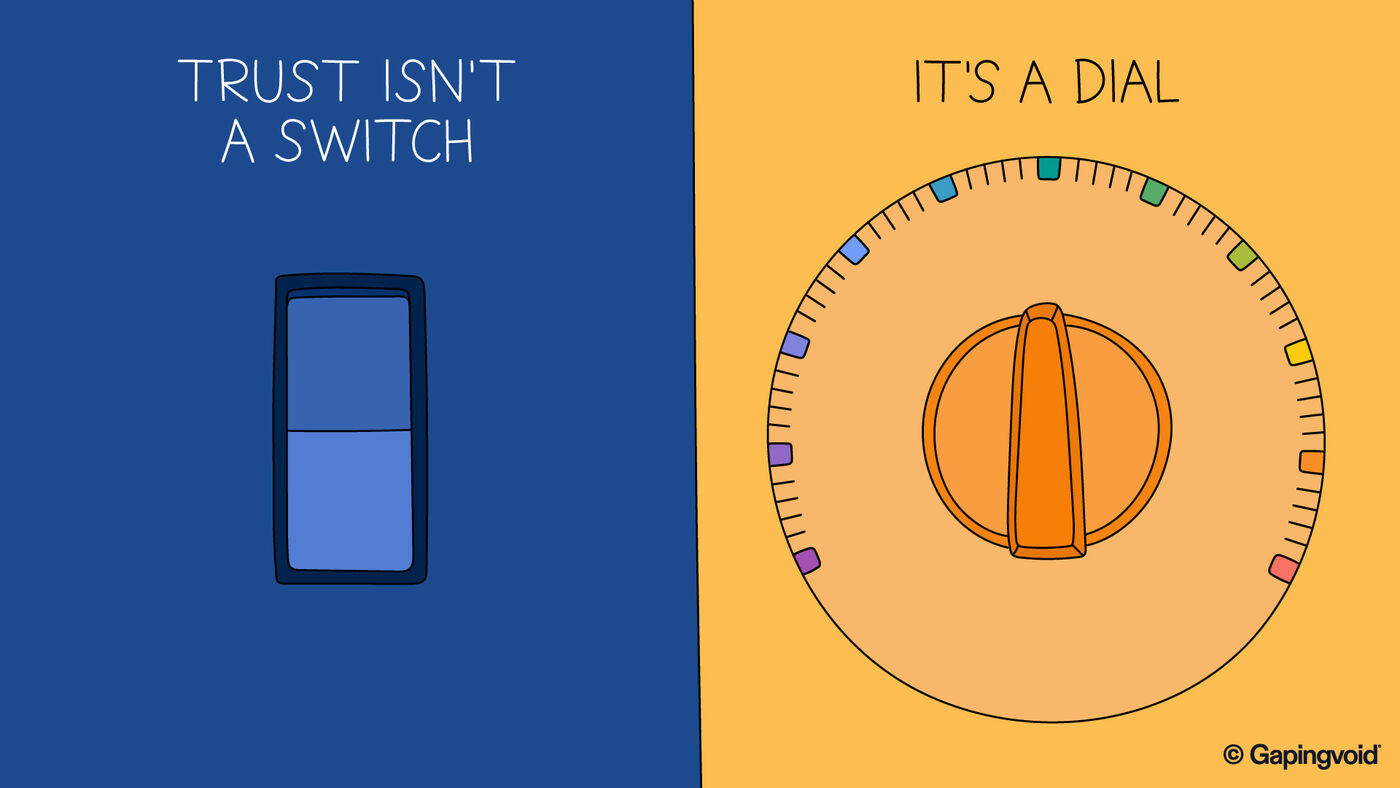
If there’s one idea running through the whole series, it’s that balance isn’t a midpoint. It’s range, used on purpose. None of us sits at the ideal setting on every dial, because there isn’t one. We lean, and under pressure we lean harder, back towards whatever has felt safest before. That’s not a failing. It’s what people do. Barry Johnson’s work on polarities makes a similar point: some problems are not there to be solved but to be managed over time, by noticing when you’ve stayed on one side too long and moving before the costs pile up. So the useful question was never “what’s the right setting?” It’s “where does my dial tend to sit, and can I move it when the moment needs me to?”
The part you can’t see
Here’s the difficulty that sat underneath every article. You are not the best judge of which way you lean. You know your intentions, and other people know your effect. You remember the restraint, and they remember the silence. You remember the high standards, and they remember the rewrites. Neither view is wrong, but they’re built from different evidence. Simine Vazire’s research on self–other knowledge suggests that other people are often better than we are at judging the traits that are visible and carry a strong sense of good or bad. Those are exactly the traits this series has been about. How much room you take, how you push back and whether you rescue are all things the people around you see more clearly than you do.
Why others keep you where you are
There’s one more thing worth knowing, and it’s the part people most often miss. Your behaviour has become the conditions for everyone around you, and they’ve adjusted to it. If you’ve always stepped in, they’ve learned to sit back. If you’ve always gone along, they’ve stopped asking what you think. If you’ve always had the answer, they’ve stopped offering theirs. Over time, those adjustments settle into a pattern that holds you in place.
So when you try a little more of the opposite, the system often pulls you back. Nobody does this on purpose. People are simply responding to the person they’ve learned to expect, and your small step can look odd, or even unwelcome, at first. That’s why change in how you lead rarely happens alone, and why the first story you tell yourself, “this isn’t working, they don’t want it”, deserves a second look before you give up on the move.
Ask them
The way out runs through the same people who hold you in. Tell them what you’re working on. Ask them which way they think you lean, and what they’d like a little more of. Then ask them to notice when you try. That turns the people who keep you in your old pattern into the people who help you out of it, and it changes the conditions for them too, because it shows them that saying what they see is safe and worth doing.
You can do this with a simple conversation, and I’d encourage you to. If you’d like something more structured, that’s what the Behaviour 360 at Square Peg is built to do: show you the gap between how you see your lean and how the people around you experience it, approach by approach, so you know where a small move would make the biggest difference.
You won’t always get this right. I know I don’t. But every time you notice which way you leaned, and ask someone else what they saw, you get a little better at choosing.
So which way do you lean? And who around you already knows?
Find the Balance is one of Square Peg’s three practices, alongside Change the Story and Shape the Conditions.
References
- Johnson, B. (1992). Polarity management: Identifying and managing unsolvable problems. HRD Press.
- Vazire, S. (2010). Who knows what about a person? The self–other knowledge asymmetry (SOKA) model. Journal of Personality and Social Psychology, 98(2), 281–300. https://doi.org/10.1037/a0017908
Want to talk about this with your team? Square Peg works with leaders on the conditions, beliefs and behaviour behind how they lead.
Get in touch